.png)


.png)
Posting to social media is one thing. But getting genuine (and even enthusiastic) engagement from that content is a whole different battle. This is where the truly skilled social media managers and creators shine, turning posting into profits for their companies. This guide will explore how you can build a social media engagement strategy.
Before we do that, let’s back up. What is social media engagement, anyway?
Social media engagement is any action a person takes on your content beyond passively viewing it. It’s anything from likes and saves to comments and direct messages. A social media engagement strategy is the plan that decides which of those actions you are trying to earn, on which platforms, and what happens after someone engages.
Most strategies cover only the first half of that sentence. They plan what to publish and ignore what to do when the audience responds. The result is a feed that broadcasts and never listens, and engagement that looks fine in a screenshot but builds no relationship.
This guide skips the theory and hands you the workbook itself. Below is a seven-part social media engagement strategy template, filled in once for a real-world case and summarized on a single page at the end. You can copy the structure and drop in your own numbers today.
Why social media management matters more than reach
Reach tells you how many people the algorithm showed a post to. Engagement tells you how many people cared.
Algorithms reward the second number, pushing posts that earn fast comments and shares to wider audiences, which means engagement is what compounds into reach rather than the other way around.
Engagement on social media matters because it has gotten harder to earn. RivalIQ’s 2025 benchmark report found organic engagement falling year over year across every major platform. Posting volume no longer carries your feed, and you can’t hack your way to growth by hoping for a post to go viral. Instead, you need a specific and scalable strategy that focuses on compounding engagement with each new post you publish.
The social media engagement strategies that work treats engagement as a loop rather than a single broadcast event. We call it the Two-Way Engagement Loop.
Publish content built to provoke a reaction, spark the first interactions through timing and format, respond quickly to everyone who engages, then review what worked and feed it back into your production roadmap.
The template below outlines how that loop comes together in detail, with a template that you can fill in for your own social media strategy.
The social media engagement strategy template
To make the template more actionable for you, each field below is filled in with an example. Replace its answers with yours as you go.
1. Set one engagement goal (metric, target, timeline)
Pick a single primary social media metric tied to a business outcome, then set a baseline, a target, and a deadline. Tracking everything tracks nothing.
Engagement rate is the cleanest cross-platform choice. But the formula you use to calculate it matters, so decide up front whether you measure it by impressions or by followers and hold it constant so the number stays comparable month to month.
The agency in our example chooses engagement rate by impressions as its north star, because follower counts flatter and reach swings week to week.
Its 90-day baseline is 2.1% on LinkedIn and 1.4% on Instagram. The target is 3.0% on LinkedIn and 2.0% on Instagram within one quarter, with a secondary goal of replying to 90% of comments and direct messages within 24 hours.
Tip: You can use CloudCampaign’s social media analytics software to track these metrics, loop the results back into your campaign planning and creative.
2. Rank your platforms (priority stack with rationale)
You cannot win everywhere, so step two in your engagement plan is to rank platforms by where your buyers actually interact, not where a trend report says you should be. Not sure how to do that? Use a tool like SparkToro to describe your audience in plain text, and get a ranked list of platforms that your personas use most.
Sort them into a primary channel you commit to, a secondary channel you support, and a maintenance tier you keep alive without much effort. The point of the ranking channels is to give yourself permission to spend less time on the channels that do drive real engagement.
The agency in our example makes LinkedIn their primary because its buyers are there and the platform rewards conversation in the comments. Instagram is secondary, used to prove the work and show the team for recruiting. YouTube and Threads sit in maintenance, fed by repurposed content. X was dropped entirely after a quarter of near-zero return, which freed hours the team redirected into replies on LinkedIn.
3. Define the content mix (by type and format)
Plan your social content by purpose and by format, weighted toward what earns interaction on each platform. To determine that, look for data points that help you determine which formats resonate with your audience or buyer segment on which platforms.
For example, Socialinsider’s 2026 benchmarks show carousels still leading Instagram engagement while static-image engagement fell roughly 17% year over year, and short video continues to win reach. The mix below reflects that, leaning on carousels for depth and reserving static posts for announcements.
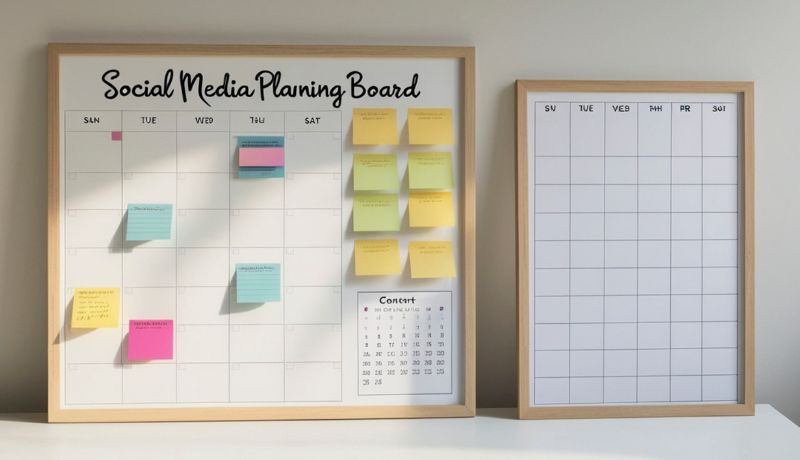
4. Set posting cadence per platform
Consistency on social media beats volume, so choose a cadence you can sustain at full quality and protect it.
As a starting range, three to five posts a week suits Instagram and LinkedIn, daily posting fits fast feeds like X. But don’t let the demands of the platform control you too much.The right number is whatever you can keep up for at least two months without quality slipping.
Our sample agency posts four times a week on LinkedIn, three times on Instagram, and repurposes one YouTube video weekly. It protects that cadence with a two-week buffer scheduled in advance, which frees the team’s daily attention for the response half instead of scrambling to publish.
Scheduling is part of that discipline, and scheduled posts don’t lose engagement when the timing fits the audience.
Tip: Use CloudCampaign’s social media scheduling tool to post natively to your client’s social media accounts to help organize and scale your content output.
5. Write your response rules
This is the field almost every strategy leaves blank, and it is the one that turns a reaction into a relationship. Replying to comments and reactions on your social content is the highest leverage action you have to turn posts into engagement flywheels.
The expectation is already set for you. Sprout Social’s 2025 Index reports that 73% of consumers expect a brand to respond on social within 24 hours, and the same share say they will buy from a competitor when a brand stays silent.
The gap is the opportunity, because roughly one in five brands still take longer than a day to respond. The fix is to write the rules down so they survive a busy week, then make them operationally possible. Pulling every comment and message into a single social inbox is what keeps a tight window enforceable instead of aspirational once volume grows.
A sample social response cadence
- Response window — every comment and DM answered within 4 working hours, never beyond 24
- First responder — the community manager owns the first reply
- Escalation — complaints or PR risk go to the account lead within 30 minutes
- Tone — first name, human, no canned copy
- First 30 minutes — every new post gets an early-reply check, since fast interaction feeds distribution
- Coverage — Monday to Friday business hours, with a weekend check on flagged accounts
6. Plan proactive weekly tactics to increase engagement organically
Engagement on social media is not only reactive. You can get in front of this reply cadence with a dedicated engagement cadence and proper tooling. Schedule your replies so they happen on purpose rather than whenever someone remembers. A standing weekly block helps you keep this from slipping.
- Comment as the brand. Spend 20 minutes a day adding real comments on posts from target accounts and partners.
- Join the niche conversation. Reply inside the hashtags and threads your audience already follows, using tactics like these Threads engagement plays.
- Ask one genuine question a week. The agency’s highest-comment format is a simple either-or question that costs nothing to answer.
- Re-engage warm DMs. Follow up on the prior week’s conversations before they go cold.
- Feature a person. Spotlight a client win or a team member to invite shares and tags.
These are all touchpoints that many social media managers get to occasionally when they have time. Put these into a scheduling tool so that you have it as an always-on nurture component of your social media strategy.
7. Run a monthly review checkpoint
Every month, review how your social media engagement strategy is performing. Read both halves of the strategy against the goal, then cut what is flat and double down on what works.
Let’s go back to our agency example. On the first Monday of each month the agency reviews engagement rate by impressions against the quarterly target, response rate and median response time, its three highest and lowest posts, and saves and shares as a quality signal. That read-out sets the next month’s content mix, and anything under target for two months running gets reformatted or dropped.
Social media engagement strategy at a glance
Here is the whole template, filled in for the agency and compressed to the skeleton you can lift into your own document. The prose above explains the reasoning behind each field. This is the version you actually fill in.
Scaling the Template Across Every Client
One brand can run this loop by hand. An agency running it for thirty clients cannot, especially when you try to scale and maintain your response times. Comments pile up, direct messages go unseen, and the 24-hour standard slips client by client until the strategy on paper stops matching the feed.
That is why a social media engagement strategy built to scale treats the response half as infrastructure rather than effort. The agencies that hold the standard centralize every client’s conversations and lean on community management built for volume, the way Concrete & Palm scaled their community management without adding headcount.
Fill in all seven fields, hold the response rules as seriously as the posting calendar, and engagement stops being a number you report. It becomes a relationship you can prove, renew, and grow.
And if you’re struggling to maintain all of this at scale a social media management platform like CloudCampaign can help keep you focussed, your team aligned, and your content structured across all client files.
d




Want 10 free social posts for your client or brand?
CloudStudio helps automate your social presence by turning your brand, website, and goals into ready-to-post content. Share your info and we’ll show you what it can create.












.png)

.png)
.png)
.png)
.png)
.png)
.png)
.png)
.png)
.png)
.png)
.png)
.png)
.png)



.png)


























.png)