.png)


Should You Build An App With AI? The Siren Call Of AI Vibe Coding
A new trend has emerged in entrepreneurial circles and home offices alike: vibe coding.
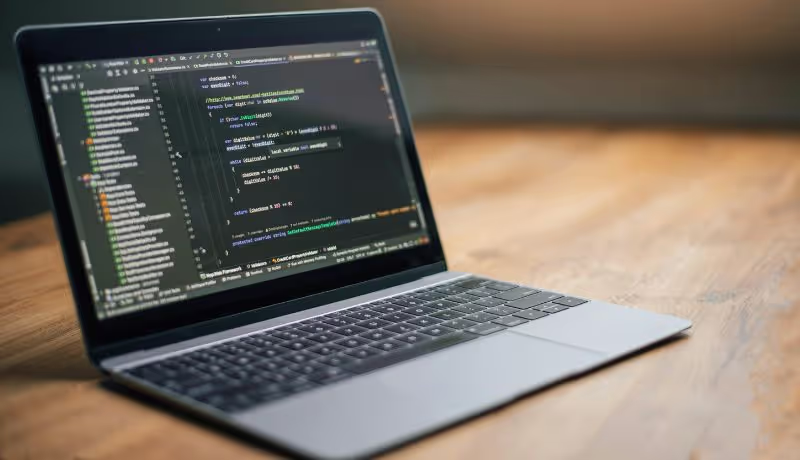
If you are wondering what is vibe coding, it refers to a shift where developers and founders use AI coding agents to describe a desired outcome rather than writing every line of syntax.
This vibe coding approach for software development is seductive. It promises that you can ship a functional MVP over the weekend and skip the six-figure developer bill.
For agency founders and software entrepreneurs, the question is simple: is vibe coding the future, or is it a shortcut to technical debt?
As we move through 2026, the data reveals an interesting, yet often untold story.
What starts as a "Bot" build often ends in an effort tax that can bankrupt your margins and stall your growth.
If you are deciding if you should build an app with AI or invest in a market-tested white-label platform, you aren't just choosing a tool.
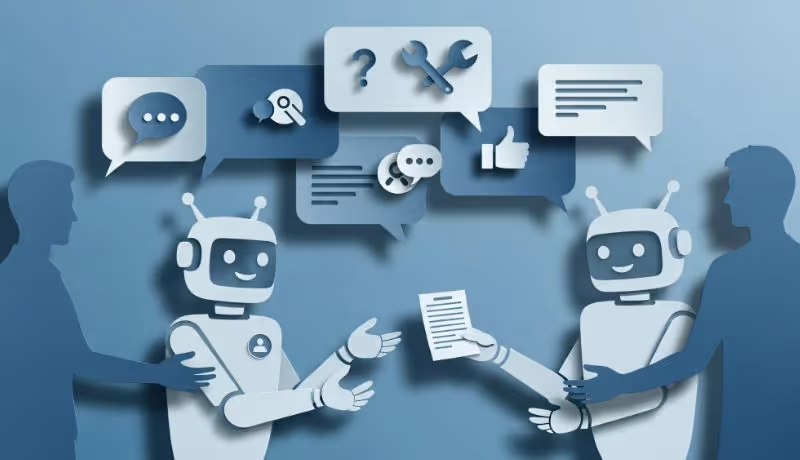
You're choosing between an expert partner that can respond to your needs versus an LLM that can only respond to your prompts, and there are pro's and con's to each.
Looking To Vibe Code Your Next App? Check Out Our Bot Or Bought White Paper Now
The Advantages and Disadvantages of Vibe Coding
There is no denying that vibe coding for software development has changed the barrier to entry.
AI coding agents like Cursor and Replit have successfully cut initial development time by 30 to 50 percent. You can technically build an app with AI in a fraction of the time it took just three years ago.
However, "shipped" does not mean "stable." The primary disadvantage is the quality-speed paradox.
Recent 2026 industry data shows that AI-generated code has a 1.7x higher bug density than human-written code.
Furthermore, these apps are 30 percent more prone to logic errors.
Because Large Language Models (LLMs) predict the next best token rather than understanding deep system architecture, they often create features that look perfect but fail under the stress of 50 or more concurrent client accounts.
A bot-made app might get you to market quickly, but you will spend the next six months in development purgatory, chasing logic errors that a human architect would have caught in the design phase.
Vibe Coding Security Vulnerabilities: The $100,000 Barrier
In 2026, "moving fast and breaking things" is a legal liability.
Regulatory bodies are still catching up to the AI boom, and vibe coding security vulnerabilities have become a major concern for enterprise clients.
Recent audits show that AI-built apps frequently miss critical security practices, leading to improper password handling and Cross-Site Scripting (XSS) vulnerabilities.
If you are building an AI-coded app today, you are facing:
- The EU AI Act: High-risk systems that lack proper documentation, something AI agents rarely generate, can face fines of up to 35 million Euros.
- SOC 2 Compliance: To win high-ticket clients, you need SOC 2 certification. The initial setup costs between $30,000 and $150,000, with annual audits adding up to $50,000 more.
When you use a white-label platform like Cloud Campaign, that architectural security and compliance infrastructure is included in your license. You inherit a $150,000 security posture on Day 1.
When you build your own tool, your budget is fragmented across hidden leaks. With a licensed platform, these costs are consolidated, making your margins easier to protect.
| Operational Layer | Custom Build (AI-Driven) | Licensed Platform |
|---|---|---|
| Initial Build | $15k–$50k (AI Prompts + Human Review) | $0 (Included in Setup) |
| API Upkeep | $15k–$25k/yr (Constant troubleshooting) | $0 (Handled by Vendor) |
| Server/GPU Overhead | $500–$2,000/mo (Scaling compute costs) | $0 (Included) |
| Security & Compliance | $30k–$150k (The "Trust Tax") | $0 (Inherited Infrastructure) |
| Year 1 Total Estimate | $70,000 – $225,000+ | $12,000 – $30,000 |
Scaling the Scaling Wall
There is a specific point where custom-built software becomes a liability.
As you add more clients, the "bug density" of AI-generated code, which currently sits 1.7x higher than professional human-grade code, creates a performance ceiling.
- Custom Build Fragility: Every new feature added via an AI agent increases the complexity of the existing code. Eventually, you spend more time "patching the engine" than driving the car.
- Platform Stability: A professional infrastructure is designed to handle thousands of concurrent users. It moves the burden of performance from your team to a dedicated engineering department.
Agility vs. Structural Debt
Choosing to build your software with AI is often an investment in technical debt. You are choosing to be a software maintenance company instead of a creative agency.
Licensing a white-label solution is a strategic move. It allows you to:
- Eliminate API Toil: Let a dedicated engineering team handle the weekly Meta, TikTok, and LinkedIn updates.
- Protect Your Margins: Avoid the growth tax of scaling custom infrastructure and unpredictable GPU costs.
- Stay Nimble: With white-labeling, you own the brand, the domain, and the client relationship without the liability of the underlying code. Changing directions is much easier and less painful.
FAQ: Building Software in the AI Era
Can you build an app with AI?
Yes. Modern AI coding agents make it possible to generate functional code bases quickly. However, the data shows these builds require significant human oversight to fix logic errors and security gaps that AI often ignores.
Can you build an app without coding?
While you can use "No-Code" tools or AI to generate the initial structure, maintaining a professional-grade SaaS product without technical knowledge is nearly impossible in 2026. The effort tax of fixing API breaks and security vulnerabilities usually requires a professional engineering team.
Is vibe coding the future?
Vibe coding is a powerful tool for prototyping and internal experiments. For client-facing, high-security, and scalable infrastructure, however, battle-tested software remains the gold standard for protecting agency margins.
What are the primary disadvantages of vibe coding?
The main risks include a 1.7x higher bug density, significant vibe coding security vulnerabilities, and the lack of proper documentation required for modern compliance like the EU AI Act.
The Verdict: Bot or Bought?
In 2026, the data is clear. If you want a hobby, build a "Bot" app. If you want to strategically position your agency to scale at a 1:50 ratio, invest in architectural infrastructure that works.
Stop building what you can buy. Your time is too valuable for babysitting AI.



Want 10 free social posts for your client or brand?
CloudStudio helps automate your social presence by turning your brand, website, and goals into ready-to-post content. Share your info and we’ll show you what it can create.













.png)

.png)
.png)
.png)
.png)
.png)
.png)
.png)
.png)
.png)
.png)
.png)
.png)
.png)


.png)
.png)
























.png)