.png)



If social media for restaurants feels easy at one location and chaotic at ten, the problem is not creativity. It is repeatability.
A single restaurant can survive on one manager filming specials between services. An agency or multi-location team cannot. You need a playbook that sells the visit, adapts by channel, protects location-level accuracy, and gives every team member the same operating model.
The work starts with content. It scales through coordination.
Social media for restaurants works when you sell the visit, not just the menu
Restaurant social fails when it treats the feed like a digital menu board.
A burger photo can remind someone you exist. A post about the first patio night of spring, the chef finishing a new sauce, or the reason a regular brings clients to the bar gives someone a reason to choose that restaurant now.
The job is to sell the visit. Your content needs to answer the question a diner is already asking. Why this place, for this meal, with these people, on this day?
For agency operators, that shift matters because it gives you a repeatable creative brief across clients. You are not starting from a blank page every week. You are translating the same core demand moments into each brand’s voice.
Dinner with friends, lunch near the office, game day, date night, family takeout, private dining, late-night dessert, and holiday catering all need different content. The menu supports those moments. It is not the whole story.
That is the first rule of social media for restaurants. The plate gets attention, but the occasion drives action.
Social media marketing for restaurants starts with the channels diners already use
Channel strategy should follow diner behavior, not the platform your team enjoys using most.
The typical social user actively uses 6.5 platforms per month, according to DataReportal and GWI. That does not mean every restaurant needs the same presence everywhere. It does mean a single-channel strategy leaves too much of the discovery journey uncovered.
For restaurant teams, the practical channel map is straightforward. Instagram carries food visuals, atmosphere, Stories, Reels, creator reposts, and local discovery. TikTok rewards personality, speed, staff energy, and simple concepts that travel beyond existing followers.
Facebook still matters for events, local communities, older diners, and location pages. Google Business Profile supports high-intent discovery when someone is already searching nearby.
The mistake is treating those channels as interchangeable distribution points. Diners use them at different stages.
Someone may find a brunch reel on Instagram, check hours on Google Business Profile, send the location to a friend through a message thread, and scan reviews before booking. UniformMarket’s 2025 data says shoppers use nearly six touchpoints on average, with half regularly using more than four. The broader point is that the buying path is fragmented across channels.
Your strategy has to match that fragmentation. Use each platform for the job it is best positioned to do, then keep the restaurant’s core story consistent across all of them.
For a broader baseline, Cloud Campaign’s guide to social media marketing best practices covers the planning habits that apply across industries.
How to use social media for restaurant marketing without posting the same thing everywhere
The fastest way to flatten a restaurant brand is to push the same caption, crop, and call to action to every platform.
Cross-posting saves time in the calendar. It costs relevance in the feed.
A better workflow separates the idea from the execution. Start with one campaign concept, then adapt the format by channel.
A weekend special can become a tight vertical video for TikTok, a carousel for Instagram, a Story sequence with a reservation sticker, a Facebook post for the local event audience, and a Google Business Profile update for people searching nearby. Same offer. Different job.
That distinction keeps your team efficient without making the content feel cloned.
The operating question is simple. What does the diner need from this channel?
On TikTok, they need a reason to watch past the first second. On Instagram, they need a visual cue strong enough to save or share. On Facebook, they need the practical detail that makes the event worth attending. On Google Business Profile, they need current hours, location accuracy, photos, and timely updates.
For agencies, this is where templates help without making the work generic. Build reusable campaign shells for offers, events, seasonal menus, staff stories, and community posts. Then require a channel-specific version for every campaign that deserves distribution across more than one platform.
The template protects margin. The adaptation protects performance.
Restaurant social media ideas get easier when you build five repeatable content pillars
Restaurant content gets easier when your team stops brainstorming isolated posts and starts working from content pillars.
Pillars are not a creativity constraint. They are the operating system that keeps every restaurant from becoming a feed of random specials, reposted reviews, and last-minute holiday graphics.
For restaurant clients, five pillars carry most of the work.
- Menu moments that make a dish, drink, or limited-time offer feel timely
- Visit occasions that frame the restaurant around date night, lunch, happy hour, groups, catering, or events
- People and process that show chefs, servers, bartenders, prep, sourcing, and service details
- Local proof that features guests, neighborhood partnerships, press, creators, and community activity
- Practical conversion posts that make hours, reservations, online ordering, private dining, and gift cards easy to act on
This structure gives your team a balanced feed without forcing every client into the same personality. A fast-casual brand may lean harder on limited-time offers and lunch occasions. A chef-driven concept may lean harder on process and sourcing.
A multi-location group needs practical conversion posts to keep each location accurate.
The point is not to post all five pillars in equal volume. The point is to stop depending on whatever the on-site manager remembered to photograph that week.
If your team needs a broader planning model, this guide to content pillars for social media gives you a useful framework for organizing themes before they hit the calendar. For more tactical inspiration, the list of social media content ideas can help fill the gaps once the pillars are set.
Social media management for restaurants breaks first at the location level
Restaurant social does not break because the brand lacks ideas. It breaks because every location adds another layer of operational detail.
One restaurant has one set of hours, one manager, one menu, one camera roll, and one approval path. Ten locations create ten sets of local details. Add seasonal menus, delivery links, catering offers, private dining contacts, local events, staff turnover, and franchise or regional approvers, and the calendar becomes a coordination problem.
This is where agency operators feel the strain. A central team can create the campaign concept, but the location has the live truth. The downtown store knows the patio is closed for weather.
The suburban store knows the private room is booked. The franchisee knows the local school fundraiser needs a post next Thursday.
If those details live in text threads, shared drives, email chains, and last-minute Slack messages, accuracy becomes a full-time job.
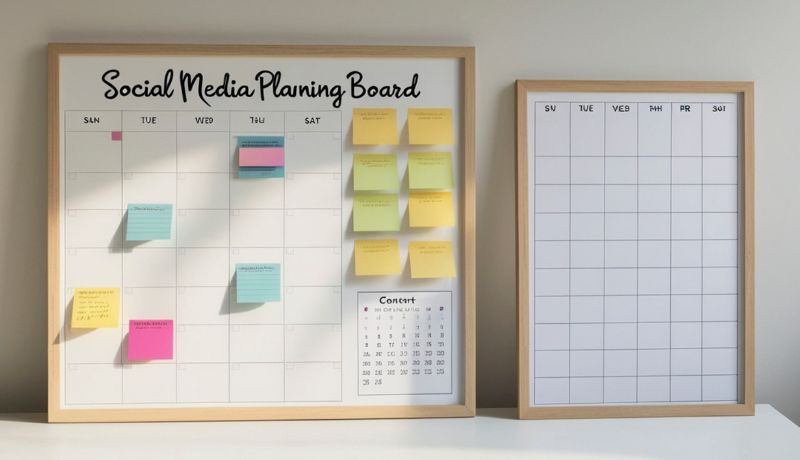
The fix is a location-aware workflow. Every location needs a clear owner, a source of truth for local details, a defined approval path, and a calendar that separates brand-level campaigns from location-specific posts.
That does not mean every location gets total freedom. It means the system gives local teams controlled inputs without letting them rewrite the brand.
A good restaurant social workflow answers four questions before content enters production.
Who can request a post? Who verifies the local details? Who approves the final version? Who owns the publishing schedule?
If those answers change every week, your process is not ready to scale.
A restaurant social media strategy should measure bookings, foot traffic, and repeat demand
A restaurant social media strategy has to measure more than likes.
Engagement matters because it shows which creative ideas earned attention. It does not prove the channel helped the restaurant fill tables, sell catering, drive online orders, or bring a guest back.
The right measurement plan connects social activity to business outcomes the restaurant already cares about. Reservation clicks, online ordering links, catering inquiries, private dining form fills, event responses, gift card sales, profile actions, direction requests, and repeat campaign performance all tell a better story than a single engagement rate.
This is where agencies can create real strategic value. Clients do not need a monthly report that says the taco reel performed well. They need to know whether taco content should become a recurring campaign, whether happy hour posts drive weekday demand, and whether one location’s community content should be replicated across the group.
Your reporting should separate three layers.
Content performance tells you which posts earned attention. Channel performance tells you where diners take action. Business performance tells you which campaigns deserve more operational support.
Those layers keep the conversation out of vanity metrics. They also help protect strategy from one-off opinions.
The owner may love polished food photography. The data may show that staff-led Reels drive more profile actions. The marketing lead may want to promote every event equally.
The data may show that private dining content deserves a stronger seasonal push.
Measurement does not remove judgment. It gives judgment something solid to work from.
Restaurant social media tools matter once the basics start working
Restaurant social media tools are not the starting point. They matter once the playbook starts working and the coordination load gets too heavy for ad hoc systems.
At that stage, the problem changes. You are no longer asking, “What should we post?” You are asking how to manage content across locations, channels, brands, approvals, assets, and users without burying the team in technical toil.
For agencies and multi-location restaurant teams, the operational layer should support the way restaurant work moves. That means a centralized dashboard for all accounts, siloed workspaces by client or location, user roles that control who can request, edit, approve, and publish, and bulk actions for managing content at scale.
It also means publishing coverage across the channels restaurants need. A platform category built for this work should support Instagram, Facebook, TikTok, and Google Business Profile alongside the broader social mix. Cloud Campaign, for example, supports publishing across eight platforms including Facebook, Instagram, Threads, LinkedIn, YouTube, Pinterest, Google Business Profile, and TikTok, with email push notifications for accounts outside direct integrations.
The content library matters just as much as the publishing queue. Restaurant teams need a taggable library for menu photos, seasonal assets, location-specific images, creator content, evergreen posts, and approved brand materials. Imports from CSV, Google Drive, and blog RSS feeds help teams bring existing assets into the workflow instead of rebuilding the library from scratch.
That is the strategic takeaway for restaurant social at scale.
Once the basics are working, the bottleneck stops being ideas. It becomes coordination across locations, promotions, platforms, assets, approvals, and people. The teams that win are the ones that treat restaurant social as an operating system, not a weekly scramble to fill the calendar.




Want 10 free social posts for your client or brand?
CloudStudio helps automate your social presence by turning your brand, website, and goals into ready-to-post content. Share your info and we’ll show you what it can create.

















.png)

.png)
.png)
.png)
.png)
.png)
.png)
.png)
.png)
.png)
.png)
.png)
.png)
.png)






.png)
.png)


























.png)