.png)


Social media for dental practices works when it answers the question patients are already asking before they call.
Will this hurt? Will I be judged? Can I trust this office with my family? Do they take my concern seriously?
That is the real job. Not filling a feed. Not posting a monthly whitening promotion. Not turning every hygienist photo into a caption about “smile confidence.”
For an agency managing dental clients, the challenge is turning trust into a repeatable content system. The practice needs enough local personality to feel human, enough educational content to lower hesitation, and enough operational structure that your team can deliver it across locations without rebuilding the plan every month.
Social media for dental practices works when it lowers patient hesitation
Social media for dental practices is not a demand-generation channel in the same way paid search is. A patient with a broken crown is going to Google first. A parent comparing pediatric dentists may ask neighbors, check reviews, scan the website, and look at Instagram or Facebook before calling.
That makes social a trust layer.
The content should make the practice feel familiar before the patient becomes a patient. That means showing the office environment, explaining common procedures in plain language, introducing the people behind the masks, and answering the questions patients hesitate to ask out loud.
The evidence points in the same direction. A BMC Oral Health study found that 41.4% of surveyed participants had interacted with dental practice social media, while 7.2% followed their dental practice on social platforms. The takeaway is not that every patient becomes a follower. It is that social media becomes part of the trust path for a meaningful segment of patients.
That distinction matters for agency workflow. If you sell dental social as a direct-response machine, the client will judge every post by immediate appointments. If you position it as a patient-confidence system, the content mix changes. You stop asking, “What can we promote this week?” and start asking, “What would make a patient more comfortable choosing this office?”
Dental social media should match how patients move across channels
Dental social media breaks when the agency treats every platform as a duplicate feed.
Patients do not move in straight lines. They see a Reel, scan Google Business Profile photos, read reviews, check Facebook for office updates, and search YouTube for a procedure explainer. DataReportal and GWI report that the typical social user actively uses 6.5 platforms per month, which means channel selection has to reflect behavior rather than internal convenience.
For dental practices, each channel needs a job.
Instagram is the visual trust channel. It can carry team introductions, office walkthroughs, before-and-after education where compliant, and short-form procedure explanations. Facebook remains useful for local community presence, family audiences, office updates, and patient-friendly reminders.
Google Business Profile supports local search confidence through photos, posts, reviews, and current practice information.
TikTok and YouTube Shorts can work when the practice has a clinician or team member who can explain dental topics naturally on camera. LinkedIn is not a patient-acquisition priority for most single-location practices, but it can matter for dental groups, DSOs, hiring, referral relationships, and community credibility. If you need a channel-specific baseline, Cloud Campaign’s guide to LinkedIn social media management best practices is a useful starting point for professional-channel strategy.
The agency move is to assign each platform a role before the calendar is built. Without that step, the same caption gets pushed everywhere, and the practice looks active without becoming more useful.
Dental social media marketing breaks when every post is a promotion
Dental social media marketing fails when it asks for trust before it earns it.
A feed full of specials trains patients to see the practice as a coupon source. That may support an occasional offer, but it does not help a nervous patient understand sedation options, a parent choose a pediatric office, or an adult decide whether to ask about implants.
The stronger content mix is built around education, proof, and familiarity. Promotions still have a place, but they should sit inside a broader system that shows care quality, not just service availability.
This is where “The Human Standard” matters. The Human Standard is the quality bar that AI output must clear to be deliverable. It should feel like something a real practice would be willing to put its name on without a full rewrite.
For dental clients, that means no generic oral-health filler. A post about flossing should sound different for a pediatric office, a cosmetic practice, an implant specialist, and a multi-location general dentistry group. The topic may be common. The judgment, tone, examples, and local context are what make it useful.
This is also where compliance and approvals enter the operating model. Patient stories, before-and-after content, clinical claims, and financing language need clear review. Your team should know which topics require doctor approval, which need signed patient consent, and which can move through a lighter review path.
If approvals are the bottleneck, start with Cloud Campaign’s guide to social media marketing best practices and adapt the workflow for dental review requirements.
Dental social media post ideas should prove care, not just announce services
Dental social media post ideas should come from patient friction. If patients are anxious, confused, skeptical, or delaying treatment, the content should reduce that friction.
That gives your team a more durable idea bank than holidays and service promos. The best ideas show how the practice thinks, how the team treats people, and what the patient can expect before, during, and after care.
Use a repeatable set of content pillars, then customize the examples by practice type.
- Before-and-after care guidance that explains what patients should do after fillings, extractions, whitening, implants, or aligner appointments
- Team introductions that connect a face, role, and patient-facing detail
- Insurance and payment explainers that clarify what patients should ask before treatment
- Procedure FAQs that answer common questions about discomfort, timing, recovery, sedation, or maintenance
- Office walkthroughs that show parking, reception, treatment rooms, technology, and accessibility details
- Patient testimonials where consent, platform rules, and local regulations allow them
- Seasonal reminders tied to back-to-school checkups, year-end benefits, sports mouthguards, wedding season, or holiday sugar habits
The point is not to make the practice look busy. The point is to make care feel easier to start.
For multi-location clients, build these ideas as templates with local variation. A root canal FAQ may have the same educational spine across locations, but the doctor quote, office photo, call to action, and patient intake detail should be location-specific. That is how you preserve local trust without forcing your team to invent from scratch for every office.
The best social media platforms for dentists each have a different job
The best social media platforms for dentists are the ones that match the practice’s patient base, service mix, and content capacity.
Instagram should carry the strongest visual proof. Use it for Reels, Stories, office culture, cosmetic education, hygienist tips, and quick explainers. It rewards practices that can show warmth and polish without feeling staged.
Facebook still matters for local relationships. It is a practical home for community events, holiday hours, patient reminders, staff milestones, and family-oriented content. For pediatric, general, and multi-generational practices, Facebook can still do real local trust work.
Google Business Profile is not a traditional social platform, but it belongs in the same operational conversation. Posts, photos, and review responses support local search behavior. For dental clients, stale photos and outdated practice information can undercut a strong Instagram feed.
YouTube works when the practice can support deeper education. Implant consultations, aligner expectations, sedation dentistry, and cosmetic treatment planning all benefit from video explanations that can be repurposed into shorter clips.
TikTok is a fit only when the content can be native to the platform. A stiff clinical monologue will not work because the format punishes corporate energy. A confident dentist or hygienist answering real patient questions can work if the practice has the appetite for speed, comments, and trend selection.
The channel decision should be honest. A three-platform plan your team can execute beats a seven-platform plan that collapses after the first month.
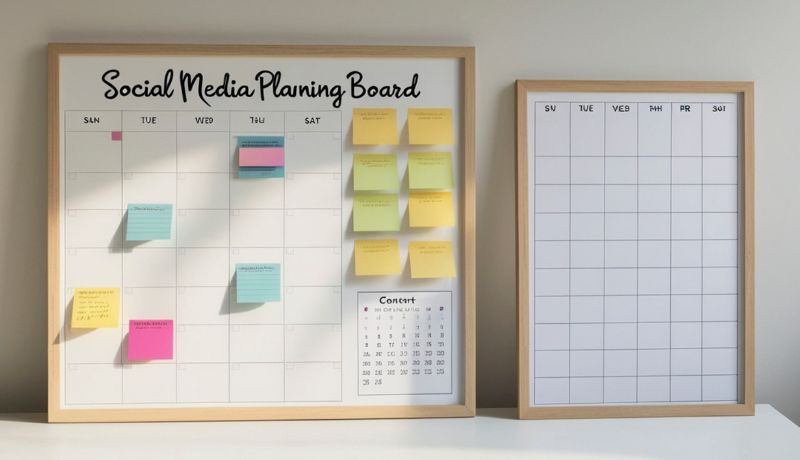
A dental social media calendar only works if the practice can repeat it every month
A dental social media calendar is not a list of dates. It is a production system.
The calendar has to account for inputs, approvals, publishing, and reporting. If the practice needs to send photos, approve captions, confirm clinical accuracy, and review patient-sensitive content, those steps need owners and deadlines. Otherwise, your agency inherits the chaos.
A workable monthly structure starts with pillars. For example, a general dentistry client might run education, team trust, procedure confidence, local community, patient proof, and appointment reminders. A cosmetic practice may put more weight on visual transformation, treatment planning, financing education, and expectation-setting.
Then the workflow needs a realistic cadence. Set the monthly themes first. Batch the captions and creative. Route clinical content for review early.
Keep evergreen posts ready for weeks when the office is slow to provide assets. Cloud Campaign’s guide to building the best social media posting schedule is a useful framework for turning that cadence into a repeatable calendar.
The mistake is letting each dental client become a custom production environment. That feels attentive at first, but it creates technical toil as you add locations. Standardize the workflow, then personalize the details patients actually notice.
Dental social media metrics should tie back to appointments, not vanity reach
Dental social media metrics should tell the practice whether social is improving patient confidence and appointment intent.
Reach and likes are useful diagnostics. They are not the business case. A post that reaches a large audience outside the service area may look good in a report and do nothing for the practice.
A lower-reach explainer that drives profile visits, website clicks, calls, direction requests, or consultation questions may be more valuable.
For agency reporting, separate the metrics into three layers.
Visibility metrics show whether the practice is being seen. Engagement metrics show whether the content is useful enough to earn reactions, saves, shares, comments, or messages. Conversion-adjacent metrics show whether patients are moving toward action through calls, clicks, booked consultations, form fills, direction requests, or review activity.
The report should also include content learning. Which procedure topics created questions? Which team posts earned comments from local patients? Which videos held attention long enough to justify more production? Which platforms produced no meaningful signal?
That is the difference between reporting activity and managing a social program. The client does not need a prettier spreadsheet. They need to know what to keep doing, what to stop doing, and what to test next month.
For dental-specific support, Cloud Campaign’s partner directory includes My Social Practice, a certified agency partner focused on dental social media, SEO, reputation management, and related services.
The broader lesson is operational. Once the content system works, the bottleneck becomes scale. Agencies managing multiple dental practices or multi-location groups need infrastructure that keeps accounts separate, approvals clean, assets organized, and publishing consistent across channels.
That is where a multi-client social media management platform becomes a strategic consideration. Cloud Campaign, for example, is built around a centralized dashboard with separate client workspaces, multi-platform publishing across Facebook, Instagram, Threads, LinkedIn, YouTube, Pinterest, Google Business Profile, and TikTok, permission roles, a taggable content library, and bulk account management.
The tool comes after the system. Build the patient-trust engine first. Then put it on infrastructure that lets your agency repeat it without adding another layer of manual work.




Want 10 free social posts for your client or brand?
CloudStudio helps automate your social presence by turning your brand, website, and goals into ready-to-post content. Share your info and we’ll show you what it can create.










.png)

.png)
.png)
.png)
.png)
.png)
.png)
.png)
.png)
.png)
.png)
.png)
.png)
.png)




.png)
.png)

























.png)