.png)



Social media for nonprofits works when it keeps the mission in front of the people who already care about it, in the long stretches between the moments when you ask them for something.
Most nonprofit feeds are built backwards. They go quiet for ten weeks, then post daily for the two weeks before the gala or the giving day, then go quiet again. Supporters learn that a post from the organization means an ask is coming, and they scroll past.
For an agency managing nonprofit clients, the job is turning that pattern into a steady system: enough story and impact content to keep donors and volunteers close, enough structure that the executive director can approve a month in ten minutes, and enough reuse across clients that the agency can serve a dozen organizations without a dozen separate processes.
Social media for nonprofits is a relationship channel, not a fundraising channel
Social media for nonprofits rarely closes a gift on its own. The donation happens on the website, at the event, through the year-end letter, or in a conversation with a development officer. What social does is keep the organization present and credible so that when the ask arrives, it lands with someone who already feels connected.
That makes social a trust and familiarity layer. The content should show the work being done, the people doing it, and the people it serves, in a way that lets a supporter feel part of it from their phone.
This framing changes how the client judges the work. If social is sold as a donation driver, every post gets measured against the giving page. If it is positioned as the thing that keeps the donor base warm, the content mix changes, the board understands what it is paying for, and the retainer survives the months with no campaign.
A nonprofit social media strategy starts with the audiences, not the platforms
A nonprofit social media strategy breaks when it treats "the public" as the audience. A nonprofit usually has four or five distinct groups who follow it for different reasons, and a feed that speaks to all of them at once speaks to none of them.
Individual donors want to see impact and feel appreciated. Volunteers want to know what is coming up and see themselves in the content. Corporate partners and sponsors want visibility and proof that the organization is well run. Program participants and their families want dignity and useful information. Board members want to see the organization look credible to their own networks.
Map those groups first, then assign each content pillar an audience. An impact story serves donors. A volunteer spotlight serves volunteers and recruits more of them. A partner thank-you serves the sponsor and signals to the next one. Once your team sees the feed as a rotation across audiences, the calendar fills itself and the organization stops sounding like a single fundraising voice.
Social media marketing for nonprofits has to pass the board and the beneficiary
Social media marketing for nonprofits carries two review standards most commercial clients never face.
The first is the board and leadership. Executive directors answer to boards, and boards see social media. Tone, accuracy, and how the organization represents the people it serves all get noticed. Program claims, financial language, and anything that touches on a partner or a funder need an approval path with a clear owner.
The second is the people in the content. Stories about participants, clients, patients, or families are the most powerful content a nonprofit has, and they require consent, care, and sometimes a different approach entirely. Your team should know which program leads can approve a story, which organizations require signed releases, and which topics should never appear on the feed regardless of permission.
Build the approval flow for that reality. One link, the whole month visible, the executive director or communications lead approving from a phone, with a second sign-off available for the program lead or board member when a post needs it. The organization will not log into a tool, and approvals sent one post at a time over email will stall. Design for a leader who has forty minutes between meetings.
This is where AI needs a clear lane. Tools like CaptionAI, ImageAI, and the AI Social Inbox can take an impact note from a program manager and a photo from an event and produce a caption in the organization's voice, a clean visual, and a thoughtful reply to the comment thread. The human standard still applies: an organization's story about a family it served should sound like that organization and respect that family. The judgment stays with your team and the client. The AI handles the volume.
Nonprofit social media post ideas should show impact between campaigns
Nonprofit social media post ideas should come from the gap between asks. If the only reason to post is a campaign, the feed goes quiet and the audience drifts.
Use a repeatable set of pillars and customize by mission.
- Impact stories that show one person, one family, or one outcome, told with consent and specificity
- Program updates that explain what the organization did this month and what it means
- Volunteer spotlights and volunteer calls, with a clear next step for someone who wants to help
- Donor and partner thank-yous, named where permitted, that make generosity visible
- Behind-the-scenes content: staff, facilities, the work on an ordinary Tuesday
- Education posts that explain the problem the organization exists to solve, in plain language
- Event promotion and recaps, with the recap doing as much work as the promotion
- Giving-day and campaign appeals, placed inside the rotation rather than replacing it
The ratio matters. If three out of four posts build the relationship, the fourth one, the ask, performs. If four out of four are asks, none of them do.
For organizations with chapters or multiple programs, build these ideas as templates with local detail. A volunteer call has the same spine in every chapter, but the date, the location, the coordinator, and the photo should be specific to each one.
The best social media platforms for nonprofits each reach a different supporter
The best social media platforms for nonprofits are the ones where the organization's actual supporters already are.
Facebook remains the center for most community nonprofits. The donor base skews older, event sharing works, groups and community threads amplify local causes, and it is where many supporters will look for an organization after hearing about it.
Instagram carries the visual story: impact photos, Reels from events, staff and volunteer moments. It matters for organizations with a younger donor or volunteer base and for anything with a strong visual component.
LinkedIn is the most underused channel in the sector. Corporate partners, sponsors, foundation staff, and board members are there, and an organization that posts credible program updates and partner thank-yous on LinkedIn makes the next sponsorship conversation easier.
YouTube and TikTok work when the organization has stories that hold attention on video and someone comfortable telling them. A two-minute program explainer on YouTube can be cut into Reels and TikToks for months.
Google Business Profile matters for any organization with a physical location people visit: a shelter, a clinic, a food bank, a community center. Hours, photos, and posts affect whether people find it.
Pinterest is a quiet performer for organizations with evergreen how-to or awareness content. Threads can extend text-first updates to a newer audience with little extra work.
Pick three the organization can sustain. A consistent presence on the right three beats a thin presence on seven.
A nonprofit social media calendar has to survive the quiet months
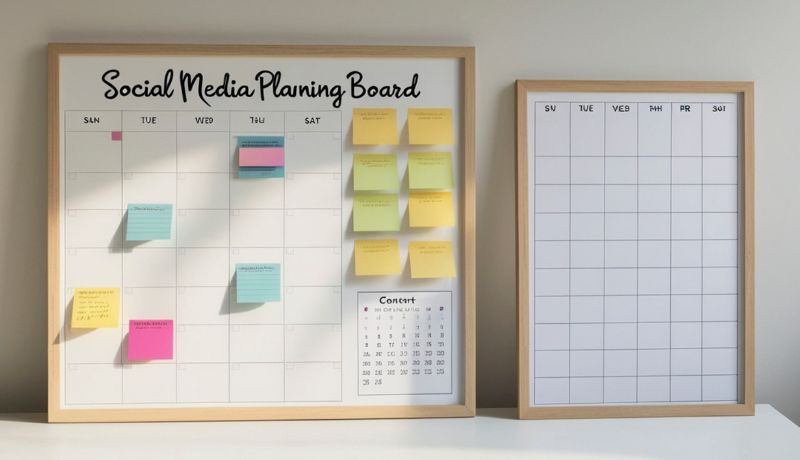
A nonprofit social media calendar gets tested in the stretch between the spring event and the year-end campaign, when there is no deadline and the communications lead is wearing four other hats.
That is the stretch the system has to carry on its own. Impact stories, volunteer calls, donor thank-yous, and education posts should already be in an evergreen queue that keeps publishing on a cadence you set, so the organization stays present between campaigns without anyone remembering to post.
A workable annual structure starts with the fundraising calendar: giving day, year-end, the signature event, any awareness month tied to the mission. Build the campaign content around those. Then fill the gaps with the pillars above, batch the evergreen content a quarter at a time, and route anything with program claims or beneficiary stories to the right approver early.
The mistake is treating each organization as a custom production environment. Standardize the workflow and the approval path, then personalize the stories, the people, and the mission language that supporters actually respond to.
Nonprofit social media metrics should connect to the development plan
Nonprofit social media metrics should tell the executive director and the board whether social is strengthening the relationships the development plan depends on.
Reach and followers are diagnostics. The questions that matter are whether supporters are engaging with impact content, whether volunteer calls produce sign-ups, whether event posts drive registrations, whether partner thank-yous get shared by the partner, and whether traffic from social shows up on the giving page during a campaign.
For agency reporting, keep three layers. Visibility shows whether the organization is being seen by its community. Engagement shows whether the content is meaningful enough to earn shares, saves, and comments from real supporters. Action metrics show movement: link clicks, sign-ups, registrations, messages, and campaign-period referrals.
Add a content learning line. Which stories got shared? Which volunteer calls produced sign-ups? Which partner post got reshared by the partner? That is what tells the organization what to keep doing next quarter, and it is what makes the report useful to a board.
Once the content system works for one organization, the bottleneck becomes scale. Agencies that specialize in nonprofits run the same relationship playbook for every client, and the operational question becomes how to do that across a roster without a separate process for each one.
That is where a multi-client platform becomes a strategic decision. Cloud Campaign gives each organization its own workspace, lets your team send a campaign content plan to every nonprofit workspace at once, keeps evergreen queues publishing between campaigns, runs approvals from a single link the executive director can open on a phone with a second sign-off for the board or a program lead, and generates branded reports for every organization in one step. If that is the problem you are solving, the nonprofit marketing agency page covers the workflow in detail, and the guides to client approvals and reporting and analytics cover the two pieces that matter most in this vertical.
The tool comes after the system. Build the relationship engine first, with the audiences and the stories. Then put it on infrastructure that lets your agency repeat it for every organization you serve.




Want 10 free social posts for your client or brand?
CloudStudio helps automate your social presence by turning your brand, website, and goals into ready-to-post content. Share your info and we’ll show you what it can create.














.png)

.png)
.png)
.png)
.png)
.png)
.png)
.png)
.png)
.png)
.png)
.png)
.png)
.png)




.png)
.png)



























.png)